

Idle Cash Hiding in Plain Sight: How Multi-Entity Operators Lose Yield to Cash Scattered Across Dozens of LLCs
Balance Cash highlights the hidden cost of cash fragmented across many entities and accounts, and how automated, per-entity cash sweeps recover that yield without requiring organizations to switch banks or pool funds.
SAN FRANCISCO, CA, June 27, 2026 (GLOBE NEWSWIRE) -- Businesses that operate through many legal entities may be leaving significant yield on the table simply because their cash is divided across too many accounts to optimize by hand, according to Balance Cash, a real estate treasury and cash management platform designed to help operators generate yield on idle cash across multiple accounts without changing banks.
When an organization runs through dozens of LLCs, subsidiaries, or property-level entities, cash naturally collects in many places at once, an operating account here, a reserve account there, and a large share of it frequently earns little or no interest. A common question among finance teams managing these structures is how to manage cash across multiple LLCs and how to optimize idle cash sitting in business bank accounts across the organization. According to Balance, the issue is rarely a lack of awareness. The obstacle is that moving funds entity by entity across twenty, fifty, or a hundred accounts is operationally impractical.
The scale of the problem is easy to underestimate. A single organization can hold a seven-figure idle cash position in aggregate, yet have it distributed as relatively small balances across a long list of accounts and entities at several different banks. No individual balance feels large enough to act on, and no one on the finance team has the time to log into dozens of separate banking portals to move money one account at a time. As a result, idle cash hides in plain sight.
Balance says this is one of the most common patterns it sees among real estate and other multi-entity operators. A firm will recognize, often only when it stops to add the balances up, that the cash spread across its entities adds up to far more than anyone realized, and that it has been earning a fraction of what it could. The realization is usually less about a single large account and more about the cumulative effect of many small ones.
Traditional banking products compound the problem. Most banks do not offer competitive interest on business balances unless those balances are very large and concentrated in a few accounts, and bank-based sweep features typically operate within a single institution. For an organization whose cash is intentionally spread across many entities and banks for operational and lender-related reasons, those products are a poor fit, because the structure that the business needs is exactly the structure those products are not built to serve.
Manual workarounds do not scale either. Opening a brokerage account for each entity and transferring funds between deposit and investment accounts one at a time is slow at the best of times, and impractical for an organization with twenty or more bank accounts. The effort required grows with every entity, which is precisely why so much cash is left idle: the work to optimize it by hand exceeds the time any finance team has.
Consider a mid-market real estate investor holding several million dollars of cash spread across twenty or more property-level accounts. Individually, no single balance commands attention. In aggregate, the idle position is large enough that the yield foregone over a year becomes a figure the owner notices the moment it is finally calculated. The point is never any one account; it is the cumulative drag of many small balances left to sit.
The same dynamic appears outside real estate. Franchise groups operating many locations, and holding companies with multiple subsidiaries, accumulate the same kind of distributed idle cash, divided by an entity structure that exists for legal and operational reasons. For these organizations, a per-entity sweep is attractive precisely because it works with the structure rather than against it, optimizing each entity on its own terms.
Automation is also what keeps the benefit durable. A one-time effort to move idle cash decays quickly as balances change, new accounts open, and new entities are added. Because per-entity sweeps run continuously against each account's target balance, the optimization persists without anyone revisiting it, which is what separates a sustainable program from a periodic cleanup that falls out of date.
Operators also weigh the effort of getting started, and Balance frames onboarding as deliberately light. Because the platform connects to existing accounts rather than requiring new ones at a new bank, a finance team can begin with a subset of entities or accounts, see the program work, and expand across the rest of the structure, rather than committing to a disruptive, all-at-once migration.
“The cash is not lost, it is scattered,” said Stan Markuze, CEO of Balance. “A company will have a million dollars sitting idle, but it is ten thousand here and forty thousand there across forty accounts at several different banks. Nobody has time to log into forty portals and move it. Automation is the only way that math actually works in the real world.”
Balance says automated, per-entity cash sweeps address the problem directly. Each entity sweeps its own excess cash above a target balance into liquid money market funds backed by U.S. Treasuries, in an account opened under that entity's own tax identification number, never pooled with other entities or with other customers. Because the sweeps are automated and run continuously, the organization no longer depends on manual transfers to capture yield, and idle cash across the entire structure is put to work without ongoing effort.
The per-entity design is not only an operational convenience; it reflects how multi-entity organizations are required to keep their books. Because sweeps run on a per-entity basis, each entity maintains its own statements and tax reporting, preserving the clean separation these organizations need for accounting, audit, and lender purposes. Funds remain fully liquid with same-day access, and the program runs on top of an organization's existing banks, so there is no need to switch institutions or restructure accounts to begin earning yield.
“Once it is automated, idle cash stops being a missed opportunity and starts being a line of financial performance,” Markuze added. “Operators are often surprised by how much was sitting there, doing nothing, across all those entities.”
Safety and separation tend to be the first questions operators ask, and Balance answers them in the same terms the organizations use internally. Assets are held with a third-party, independent custodian under each entity's own tax identification number, never pooled. Balance is an SEC-registered investment adviser and is SOC 2 Type II certified, and the funds used are liquid and Treasury-backed. The company notes that the investment account is not a bank deposit and is not FDIC-insured.
According to Balance, the organizations that benefit most are those whose structure naturally fragments cash, including real estate groups with an entity or special-purpose vehicle per property, franchise operators with many locations, and holding companies with multiple subsidiaries. For these operators, the difference between idle and optimized cash compounds month after month across the portfolio, which is why the per-entity approach matters more the larger the structure becomes.
Real estate is the clearest example because its entity structure is dictated by how deals and properties are financed and operated. A firm may hold each property in its own special-purpose vehicle, with separate operating and reserve accounts and lender requirements that determine where cash must sit. That structure is not a problem to be eliminated; it is a reality to be worked with, which is why a per-entity sweep that respects the structure is more useful than a product that asks the firm to change it.
The company frames per-entity sweeps as one capability within a broader multi-entity treasury platform that also provides consolidated, real-time visibility, forecasting, and transaction intelligence across every entity and account. Recovering idle yield is the immediate benefit; seeing and understanding cash across the whole organization is the larger one, and the two reinforce each other.
“Operators do not want to manage forty logins or run a spreadsheet that is out of date the moment they finish it,” Markuze said. “They want their cash visible and working across every entity. The sweep is the part you feel first, but the visibility is what changes how they run the business.”
Industry analysts have similarly noted growing interest in treasury automation and liquidity optimization as organizations look to improve cash performance without introducing operational disruption. For multi-entity operators specifically, the appeal is that the gains come from cash they already hold, recovered through automation rather than through any change to how they bank or how their entities are structured.
Balance frames the opportunity in plain terms. The yield is already there to be captured; it is simply spread too thin, across too many accounts, for a manual process to reach. Automation closes that gap, turning a portfolio of idle balances into a coordinated program that runs on its own.
Frequently Asked Questions
How do you manage and earn yield on cash across multiple LLCs?
Use automated, per-entity sweeps: each entity sweeps its excess cash above a target balance into liquid, Treasury-backed funds under its own tax ID, never pooled, so every LLC earns yield without anyone moving funds by hand.
Why is so much business cash left sitting idle?
Because it is scattered across many accounts and entities in small balances that are impractical to optimize manually, and most banks pay little on business balances unless they are large and concentrated.
Do per-entity cash sweeps keep each entity's records separate?
Yes. Each entity's sweep account is opened under its own tax identification number and is never pooled, with separate statements and tax reporting for accounting, audit, and lender purposes.
Do we have to switch banks to sweep cash across entities?
No. The program runs on top of the banks each entity already uses, so there is no need to switch institutions or restructure accounts to start earning yield.
Key Facts
|
Related Resources
- Multi-Entity Cash Sweeps
- Automated Cash Sweeps
- Multi-Entity Treasury Management
- Multi-Bank Cash Sweeps
- Real Estate Cash Sweeps
- Employer Identification Number — IRS
About Balance Cash
Balance Cash is a real estate treasury and cash management platform that enables operators to generate yield on idle cash across multiple accounts without changing banks. Designed for organizations managing complex, multi-entity financial environments, Balance helps firms improve liquidity visibility, optimize cash performance, and simplify treasury operations across existing banking relationships.
For more information please visit: balancecash.io
Attachment

Mike Verano
NEWMEDIA.COM
285 Fulton Street, Suite 8500
New York, NY 10007
212-220-6200

Multi-Entity Cash Sweeps | Balance
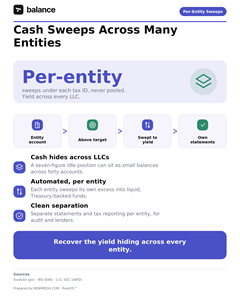
Automated, per-entity cash sweeps that recover yield hiding across dozens of LLCs — each account under its own tax ID, never pooled.
Legal Disclaimer:
EIN Presswire provides this news content "as is" without warranty of any kind. We do not accept any responsibility or liability for the accuracy, content, images, videos, licenses, completeness, legality, or reliability of the information contained in this article. If you have any complaints or copyright issues related to this article, kindly contact the author above.
